
This is a question I hear quite often from patients, athletes, and fitness enthusiasts alike: “Does creatine cause hair loss?” The short answer is no, creatine itself has not been proven to cause hair loss. While one study years ago raised concerns about a possible link, more recent research has not confirmed those findings. In this article, I’ll explain what we know so far, what the science says, and what I’ve seen in my own practice.
What Is Creatine and Why Do People Use It?
Creatine is a naturally occurring compound made by your body. It helps produce ATP, which is the main source of energy for your muscles during short bursts of activity. This is why so many athletes and gym-goers use creatine supplements: it helps improve strength, power, and recovery after workouts.
It’s important to understand that creatine is not a steroid or hormone. It’s actually made from amino acids and can be found in everyday foods like red meat and fish. In supplement form, it simply increases your muscle’s natural creatine stores, allowing you to work out harder and longer.
The Origin of the Hair Loss Concern
The idea that creatine might cause hair loss began with a single 2009 study from South Africa. In this small, short-term trial, 20 male college rugby players took a creatine loading dose (25 grams per day for one week) followed by a maintenance dose (5 grams per day for two weeks).
After three weeks, the researchers found that the players’ levels of dihydrotestosterone (DHT), the hormone linked to male pattern baldness, increased by about 56% from baseline and were 40% higher than the placebo group. Testosterone levels, however, stayed the same.[1]
While those numbers sound dramatic, the study had several major limitations. It involved only 20 participants, lasted just three weeks, and didn’t measure actual hair loss or thinning. The researchers only looked at hormone levels, not visible changes in hair. Still, this small study sparked years of online speculation and created the lasting myth that creatine causes hair loss, even though no later studies have confirmed the finding.
Also Read: Norwood Male Hair Loss Scale: Stages & Treatment Options
What Later Studies Have Found
Since then, several studies have revisited this question. None have been able to replicate the findings of that 2009 study. In fact, a 2017 systematic review on creatine’s safety found no hormonal changes or disruptions that could explain hair loss. Sports medicine research continues to classify creatine as one of the safest and most effective supplements for performance enhancement.
The 12-Week Randomized Controlled Trial (2025)
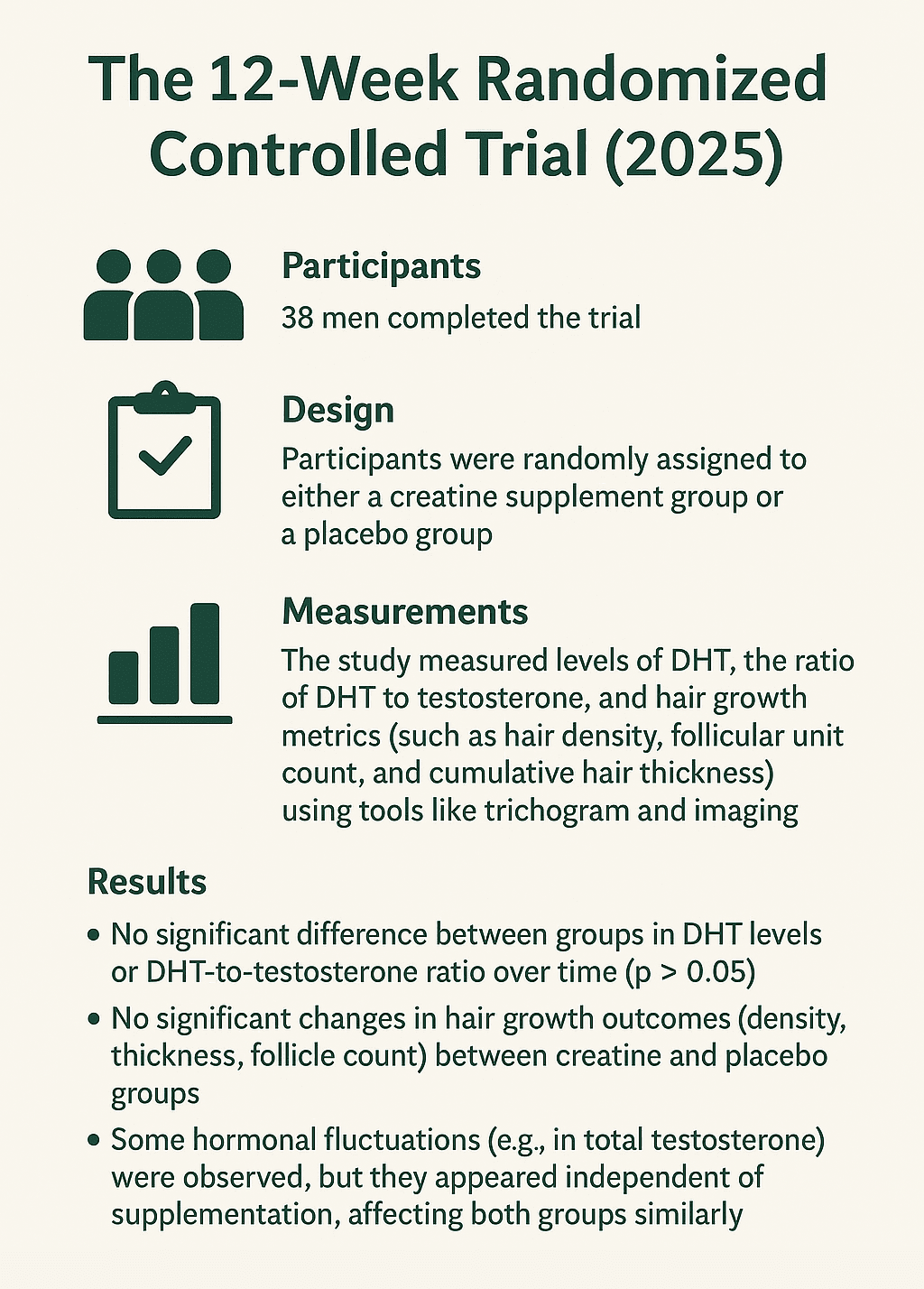
One of the strongest pieces of evidence is a recent 12-week double-blind RCT in resistance-trained men.
- Participants: 38 men completed the trial.
- Design: Participants were randomly assigned to either a creatine supplement group or a placebo group.
- Measurements: The study measured levels of DHT, the ratio of DHT to testosterone, and hair growth metrics (such as hair density, follicular unit count, and cumulative hair thickness) using tools like trichogram and imaging.
- Results:
• No significant difference between groups in DHT levels or DHT-to-testosterone ratio over time (p > 0.05).
• No significant changes in hair growth outcomes (density, thickness, follicle count) between creatine and placebo groups.
• Some hormonal fluctuations (e.g. in total testosterone) were observed, but they appeared independent of supplementation, affecting both groups similarly.
The authors concluded that this was the first study to directly look at how creatine affects hair health, and their results strongly suggest that creatine does not cause hair loss.[2]
Most dermatologists and endocrinologists agree with this conclusion: creatine does not cause hair loss. The biggest influence on whether someone develops baldness is their genetics, not what they mix into their post-workout shake.
Understanding DHT and Genetic Hair Loss
DHT is a byproduct of testosterone and plays a major role in androgenetic alopecia, also known as male pattern baldness. People who are genetically sensitive to DHT may notice gradual thinning over time, especially on the crown and hairline.
Even if creatine were to cause a slight rise in DHT, that doesn’t mean it would automatically lead to hair loss. For most people, the body regulates hormone levels naturally. Only those with a strong genetic predisposition are affected by DHT enough to cause visible thinning. In other words, creatine might not be the problem; your genes likely are.
Also Read: Hair Growth Cycle: All You Need to Know
Side Effects Caused by Creatine
Creatine is generally very safe when taken in recommended amounts, but like any supplement, it can have some mild side effects. The most common include:
- Water retention (feeling bloated)
- Muscle cramps or stomach discomfort, if taken without enough water
- Weight gain, usually from increased water in the muscles
- Digestive upset in some users
These effects are usually temporary and can be managed by staying hydrated and avoiding excessive doses.
Alternatives to Creatine
If you are still concerned about creatine or simply want other options, there are several alternatives that can help with energy and performance:
- Beta-alanine: Improves endurance and reduces fatigue during workouts.
- BCAAs (Branched-Chain Amino Acids): Support muscle recovery and reduce soreness.
- Protein supplements: Help build and repair muscle tissue without affecting hormones.
- Natural sources: A balanced diet rich in lean meats, eggs, and fish can support performance without needing supplements.
These options do not affect DHT levels and are not linked to hair loss.
Creatine Effects on Women’s Hair Loss
Many women also use creatine to improve exercise performance. To date, there is no scientific evidence that creatine contributes to hair thinning or shedding in women. Female hair loss is often influenced by hormonal changes, stress, nutritional deficiencies, or genetics, not creatine use. Women who take creatine as part of a balanced fitness plan generally do not need to worry about hair loss from the supplement itself.
Also Read: Ludwig Female Hair Loss Scale: Stages & Treatment Options
What I See in My Practice
Many of my patients and athletes are using creatine and have expressed worry that it may worsen the progression of their male pattern hair loss. Over the past decade, I have found no correlation to progressive worsening of male pattern hair loss with creatine; therefore, I tell my patients it’s safe to use creatine.
It is a vastly different story for my patients who are taking supplemental testosterone. Taking supplemental testosterone definitely adds fuel to the fire in the progression of male pattern hair loss, which makes it even more important to take finasteride to block the conversion of this testosterone into DHT (i.e.- the culprit related to the progressive miniaturization of the hair follicles).
The Bottom Line
There is no conclusive scientific evidence that creatine causes hair loss. The 2009 study raised an interesting question, but follow-up research has not supported the idea that creatine leads to baldness. For most healthy adults, creatine remains a safe and effective supplement when used correctly.
If you are using creatine and noticing hair thinning, I recommend speaking with a dermatologist to explore all possible causes. In most cases, creatine is not the culprit, and with proper guidance, you can continue your fitness goals without worrying about your hair.
Worried About Hair Loss? Let’s Talk.
Get trusted answers from Dr. McAndrews, a board-certified hair restoration physician with over 20 years of experience. We serve Los Angeles through our Pasadena office and offer convenient online consultations that you can reserve from anywhere.
Sources
1. van der Merwe J, Brooks NE, Myburgh KH. Three weeks of creatine monohydrate supplementation affects dihydrotestosterone to testosterone ratio in college-aged rugby players. Clin J Sport Med. 2009 Sep;19(5):399-404. doi: 10.1097/JSM.0b013e3181b8b52f. PMID: 19741313.
2. Lak M, Forbes SC, Ashtary-Larky D, Dadkhahfar S, Robati RM, Nezakati F, Khajevandi M, Naseri S, Gerafiani A, Haghighat N, Antonio J, Tinsley GM. Does creatine cause hair loss? A 12-week randomized controlled trial. J Int Soc Sports Nutr. 2025 Sep;22(sup1):2495229. doi: 10.1080/15502783.2025.2495229. Epub 2025 Apr 23. PMID: 40265319; PMCID: PMC12020143.

Dr. Paul J. McAndrews is a world-renowned expert in hair loss and hair restoration, and one of only two physicians to have served as President of both the ISHRS and ABHRS. He is a Clinical Professor at USC/LAC Medical Center and an Expert Medical Reviewer for the California Medical Board. Known for his artistic, patient-focused approach, Dr. McAndrews performs one hair transplant per day to ensure exceptional, individualized results.