
A Dermatologist is a medical doctor who is formally trained in a medical residency in diagnosing, treating, and performing surgery on the skin and hair follicles. A Dermatologist is the medical expert to make the proper hair loss diagnosis during the patient consultation. Hair Transplantation is a medical operation in which skin grafts with hair follicles from a donor area in the back of your head are harvested and then planted into a balding area.
History of Hair Transplantation
Dr. Okuda and the Original Punch Excision (1939)
In 1939, a Japanese doctor named Dr. Okuda performed follicular unit excisions with the exact size punch 0.8-1.0 mm punch excision tool presently used by doctors who perform follicular unit excision (FUE) transplants today (1). This Japanese literature was lost following WWII.
Also Read: What’s More Important? A Hair Transplant Tool or the Doctor
Dr. Norman Orentreich (1952)
The first hair transplantation reported in the United States literature was in 1952 by Dermatologist Dr. Norman Orentreich (2), who used a 4mm circular punch excision device, which created the pluggy “doll’s hair” look. Dermatologists started using smaller punch excisions and quadrisecting the tissue in order to make it less pluggy-looking and more natural.
Dr. Bobby Limmer and the Linear Strip Technique (1990s)
The first FUT (follicular unit transplantation) surgery was done in the early 1990s by Dermatologist Dr. Bobby Limmer (3), who created the linear strip method, using a stereoscopic microscope to carefully dissect the hair grafts into their natural groupings of 1 to 4 hairs. This technique was a significant advance in creating a more natural-looking hair transplant.
Why FUT Improved Graft Survival and Quality
More importantly, FUT was a huge advance in graft survival by avoiding transection from the blind dissection created by FUE punch excisions (FUE punch excisions are blind dissection since it is unknown if the hair follicle was transected until the punch excision has already occurred). FUT hair transplants significantly increased the survival of the hair grafts since the follicular units were dissected with full visualization under the stereoscopic microscope. FUT also could remove better quality grafts from the area where the best genetic hair is located, while the FUE punch scars have to be spread out, since it creates 12 times as much surface area of scar tissue.
The FUE Revival in the 2000s and Terminology Issues
In the early 2000s, what was “old” became “new” again, and history repeated itself; doctors again started using a 1mm circular punch to excise donor tissue with the exact size punch excision tool Dr. Okuda used in 1939. Punch excision was reborn and renamed FUE (4). Instead of calling this technique its accurate former name, “punch excision”, marketing doctors initially and deceptively called this technique “Follicular Unit Extraction” to imply that it “really was not surgery”. These same unethical doctors also falsely stated there was no scarring.
The International Society of Hair Restoration Surgery (ISHRS) took a strong stance on this deception and stressed that FUE punch excisions created thousands of small circular scars from the surgical excision of the donor tissue. It was then correctly renamed “Follicular Unit Excision”. The ISHRS warned that if any members continued to unethically and falsely advertise that FUE punch excisions were scarless, they would be banned from the medical society.
Also read: Ketoconazole for Hair Loss
Why a Dermatologist Is Important for Hair Transplantation
All the people at the forefront of hair transplantation techniques were medical doctors experienced in Dermatology. And when your hair transplant surgery is performed by a surgeon who was formally trained in this procedure during their Dermatological medical residency or fellowship, you should be in good hands. It’s important that you see a doctor who performs both FUT & FUE hair transplant surgeries, as there are pros & cons to both depending upon each individual’s unique situation.
A Dermatologist is the medical expert to make the proper hair loss diagnosis during the patient consultation. Hair loss is a symptom, and depending upon the accurate diagnosis will determine the proper course of treatment with the best outcome. If surgery is recommended, your Dermatologist should perform the entire medical procedure, backed by an experienced team, to ensure the utmost quality.
Also Read: Not All Hair Transplant Surgeons are Created Equal
Dermatologists are the masterminds and specialists in the field of hair loss and hair transplantation. Dermatologists were the pioneers of both FUE & FUT hair transplantation procedures, and they continue to be at the forefront in the advancement of hair surgery.
Choosing the Right Surgeon: Training, Residency, and Credentials
A hair transplant is a medical surgery that should only be performed by a medical doctor specifically trained in this specialty during their medical residency or fellowship. You wouldn’t have heart surgery by an orthopedic surgeon, so why would you have hair surgery by somebody not formally trained in hair surgery? Always do an extensive background check on the education and training of the physician who is actually going to perform your surgery.
Worried About Hair Loss? Let’s Talk.
Get trusted answers from Dr. McAndrews, a board-certified hair restoration physician with over 29 years of experience. We offer both FUE and FUT hair transplants in Los Angeles at our Pasadena office and offer convenient online consultations that you can reserve from anywhere.
Sources
1. Inui S, Itami S: Dr. Shoji Okuda (1886-1962): The great pioneer of punch graft hair transplantation. J Dermatol 36:561-562, 2009
2. Choudhry N, Sood A, Steinweg S. Norman Orentreich, the father of hair transplantation. JAMA Dermatol. 2017;153:837.
[CrossRef] [PubMed] [Google Scholar]
3. Limmer BL. Elliptical donor stereoscopically assisted micrografting as an approach to further refinement in hair transplantation. J Dermatol Surg Oncol. 1994;20:789-793.
[CrossRef] [PubMed] [Google Scholar]
4. Rassman WR, Bernstein RM, McClellan R, Jones R, Worton E, Uyttendaele H. Follicular unit extraction: Minimally invasive surgery for hair transplantation. Dermatol Surg. 2002;28:720-8.
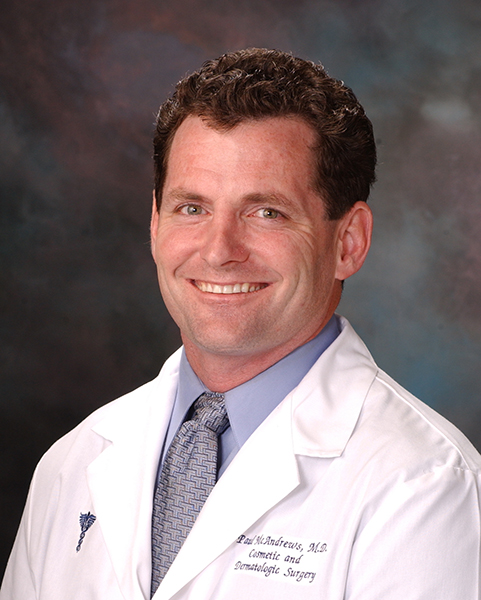
Dr. Paul J. McAndrews is a world-renowned expert in hair loss and hair restoration, and one of only two physicians to have served as President of both the ISHRS and the ABHRS. He is a Clinical Professor at USC/LAC Medical Center and an Expert Medical Reviewer for the California Medical Board, with more than 29 years of experience performing hair transplant procedures, including both FUE and FUT. Serving patients throughout Los Angeles and Southern California, he is regarded as one of the best hair transplant specialists in Los Angeles.