
What Is Spironolactone?
Spironolactone is an oral prescription medication that was FDA-approved in 1960 for conditions such as heart failure, hypertension (high blood pressure), and edema (fluid retention). It is a potassium sparing diuretic. It works by blocking the hormone aldosterone, which helps eliminate excessive salt and water while keeping potassium levels from going too low.
How Spironolactone Works for Hair Loss
Physicians also noticed patients taking spironolactone for their blood pressure had side effects of breast tenderness and reduced sex drive in men. It was discovered that this occurred because spironolactone also blocks androgen receptors (i.e., anti-androgen). This anti-androgen effect has led to many dermatologists using it off-label for acne, female patterned hair loss (androgenetic alopecia), hirsutism (excessive body hair growth), and PCOS (Polycystic Ovary Syndrome). It is often paired with topical treatments such as Ketoconazole an antifungal shampoo with mild anti-androgen properties that many dermatologists also use off-label to help slow hair thinning. Spironolactone is not used in men because, by blocking testosterone, it can cause feminization in men.
Also Read: Is THO7 a New Wonder Drug for Hair Loss?
Who Is a Good Candidate?
-
- Women with a significant family history of female pattern baldness in the early stages of thinning are good candidates for the off-label use of spironolactone. You should consult with your dermatologist before using.
- Men should not use spironolactone. Men are not good candidates since it will block the beneficial effects of testosterone and feminize men.
Dosage and How to Take It
The therapeutic range used for the off-label use of spironolactone for female pattern hair loss is 100 to 200 milligrams. Most women are slowly worked up to this dose over a few months.
Also Read: Do Peptides Help Hair Loss?
Is Spironolactone Effective for Hair Loss?
There are several studies documenting the effectiveness and benefits of spironolactone as both monotherapy and in combination therapy in the treatment of female pattern hair loss:
1. The Synergistic Effect: Spironolactone + Minoxidil (Pilot RCT)
This 24-week randomized, double-blind, placebo-controlled pilot study evaluated the impact of adding 100 mg of oral spironolactone to a standard 3% topical minoxidil regimen for premenopausal women with Ludwig stage I and II hair loss.
-
- Clinical Improvement: 38% of patients in the spironolactone group achieved “marked improvement,” compared to only 9% in the placebo group.
- Terminal Hair Density: The combination group saw a density increase of +9.48 hairs/cm², nearly double the +5.32 hairs/cm² observed in the minoxidil-only group.
- Hair Diameter: Average hair diameter increased by 4.23 μm in the test group.
- Safety Profile: Menstrual irregularities were reported by 37.5% of the spironolactone group, indicating a need for clinical monitoring in premenopausal patients.[1]
2. Long-Term Efficacy and Stabilization (Retrospective Study)
This study provided a “real-world” look at the long-term effectiveness of spironolactone by analyzing clinical outcomes over a four-year period.
-
- 100% Stabilization Rate: Every participant in the study (100%) either maintained their baseline hair density or showed improvement; no patients experienced worsening hair loss while on treatment.
- Clinical Grading: The average improvement on the Sinclair scale was 0.65 points, with patients having more advanced hair loss seeing the most dramatic results.
- Optimized Results over Time: 64% of patients achieved their peak hair density scores after one year or longer of consistent use.
- Tolerability: While 33% reported minor side effects (primarily dizziness), only 3.8% of patients discontinued the medication, suggesting high long-term compliance.[2]
3. Global Statistical Consensus (Systematic Review & Meta-Analysis)
This meta-analysis synthesized data from multiple clinical trials to establish a definitive statistical baseline for spironolactone’s role in treating FPHL.
-
- Proven Regrowth: The analysis confirmed a statistically significant increase in terminal hair count across all pooled data sets.
- Gold Standard Dosage: The study verified that daily doses between 100 mg and 200 mg provide the most consistent clinical response for hair regrowth.
- Safety Threshold: The review confirmed that serious risks, such as hyperkalemia, are statistically negligible in healthy women, supporting a shift away from frequent, routine blood monitoring.
- Primary Side Effects: The most prevalent adverse events identified across all studies were menstrual irregularities and breast tenderness.[3]
Also Read: Ludwig Female Hair Loss Scale: Stages & Treatment Options
Results Timeline: What to Expect
Similar to other treatments of androgenetic alopecia, such as finasteride and minoxidil, you judge the results on a calendar year, not a stopwatch. I tell my patients to compare their results after 1 year. I also tell patients to judge results not so much on what you see (significant thickening) but on what “you don’t see” (significant thinning).
Side Effects and Risks
-
- Again, it should not be used in men secondary to the anti-androgen side effects.
- Women can experience menstrual irregularities, breast tenderness, and breast enlargement.
- While taking spironolactone, patients should not be taking “potassium” supplements since it can cause high potassium levels (hyperkalemia), which can be dangerous to the heart rhythm.
Spironolactone vs Other Medications
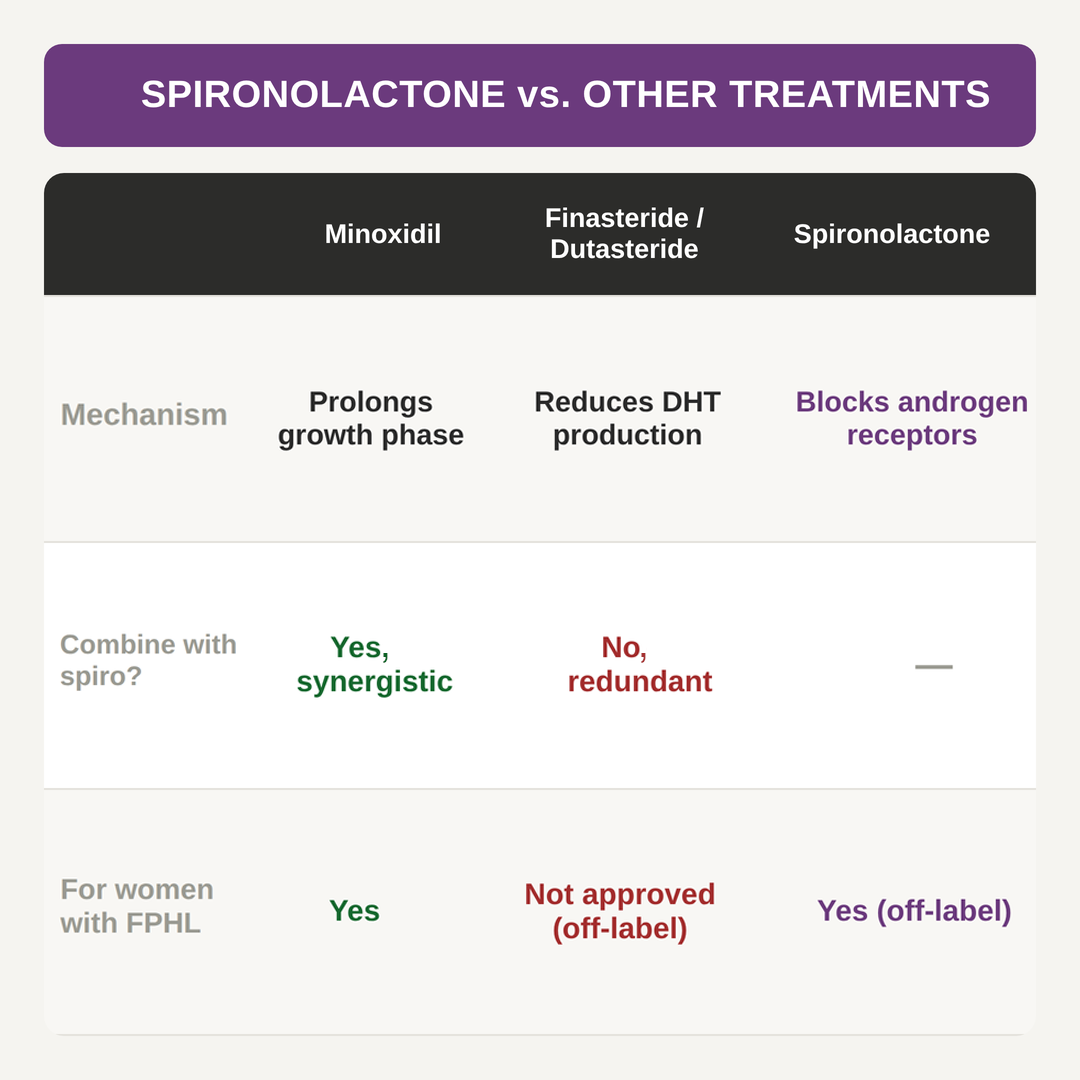
Minoxidil: Both topical and oral minoxidil work on a different mechanism of action than spironolactone in the treatment of androgenetic alopecia; therefore, they can be synergistic in combination with spironolactone in slowing the progressive thinning nature of female pattern hair loss.
Finasteride and Dutasteride: work by inhibiting the conversion of testosterone into dihydrotestosterone (DHT) by blocking type 2 alpha 5-reductase. Spironolactone blocks the testosterone and DHT receptors; it is not logical to use these in conjunction with spironolactone.
My Experience
I have prescribed the off-label use of spironolactone at doses of 100-200mg for women with androgenetic alopecia, hirsutism, PCOS, and acne for decades. I believe it is helpful as a monotherapy or combination therapy (minoxidil) in slowing the progressive thinning nature of female pattern hair loss. It is not a wonder drug, but it definitely is helpful. If you are considering spironolactone, see a board-certified Dermatologist.
Sources
- https://journals.lww.com/ijwd/fulltext/2025/10000/efficacy_and_safety_of_oral_spironolactone_for.11.aspx
- https://www.jaad.org/article/S0190-9622%2820%2930510-7/
- https://www.cureus.com/articles/166490-the-efficacy-and-safety-of-oral-spironolactone-in-the-treatment-of-female-pattern-hair-loss-a-systematic-review-and-meta-analysis#!/
Worried About Hair Loss? Let’s Talk.
Get trusted answers from Dr. McAndrews, a board-certified hair restoration physician with over 29 years of experience. We offer both FUE and FUT hair transplants in Los Angeles at our Pasadena office and offer convenient online consultations that you can reserve from anywhere.

Dr. Paul J. McAndrews is a world-renowned expert in hair loss and hair restoration, and one of only two physicians to have served as President of both the ISHRS and the ABHRS. He is a Clinical Professor at USC/LAC Medical Center and an Expert Medical Reviewer for the California Medical Board, with more than 29 years of experience performing hair transplant procedures, including both FUE and FUT. Serving patients throughout Los Angeles and Southern California, he is regarded as one of the best hair transplant specialists in Los Angeles.