
Hair loss is a symptom, not a diagnosis, so it’s of utmost importance to be examined by a dermatologist to determine your specific diagnosis for your hair loss. The medical treatments for the different forms of hair loss are drastically different.
This article focuses specifically on Androgenetic Alopecia (genetic hair loss), the most common cause of hair thinning in both men and women. We’ll review FDA-approved, off-label, and emerging medications that can be used to treat androgenetic alopecia. Before we begin, please understand the terms defined below. We’ll use them later in the article.
Also Read: Is Topical Pyrilutamide the Next Big Treatment for Hair Loss?
FDA Approved: Efficacy vs Safety
FDA-approved for Efficacy means that it has been shown to be effective for its intended use (it treats the diagnosis)
VS
FDA-approved for Safety means that it’s safe for consumer use (it has not demonstrated effectiveness for the treatment).
There is a big difference between these 2 labels – Buyer Beware!
FDA-Approved Medications for Androgenetic Alopecia
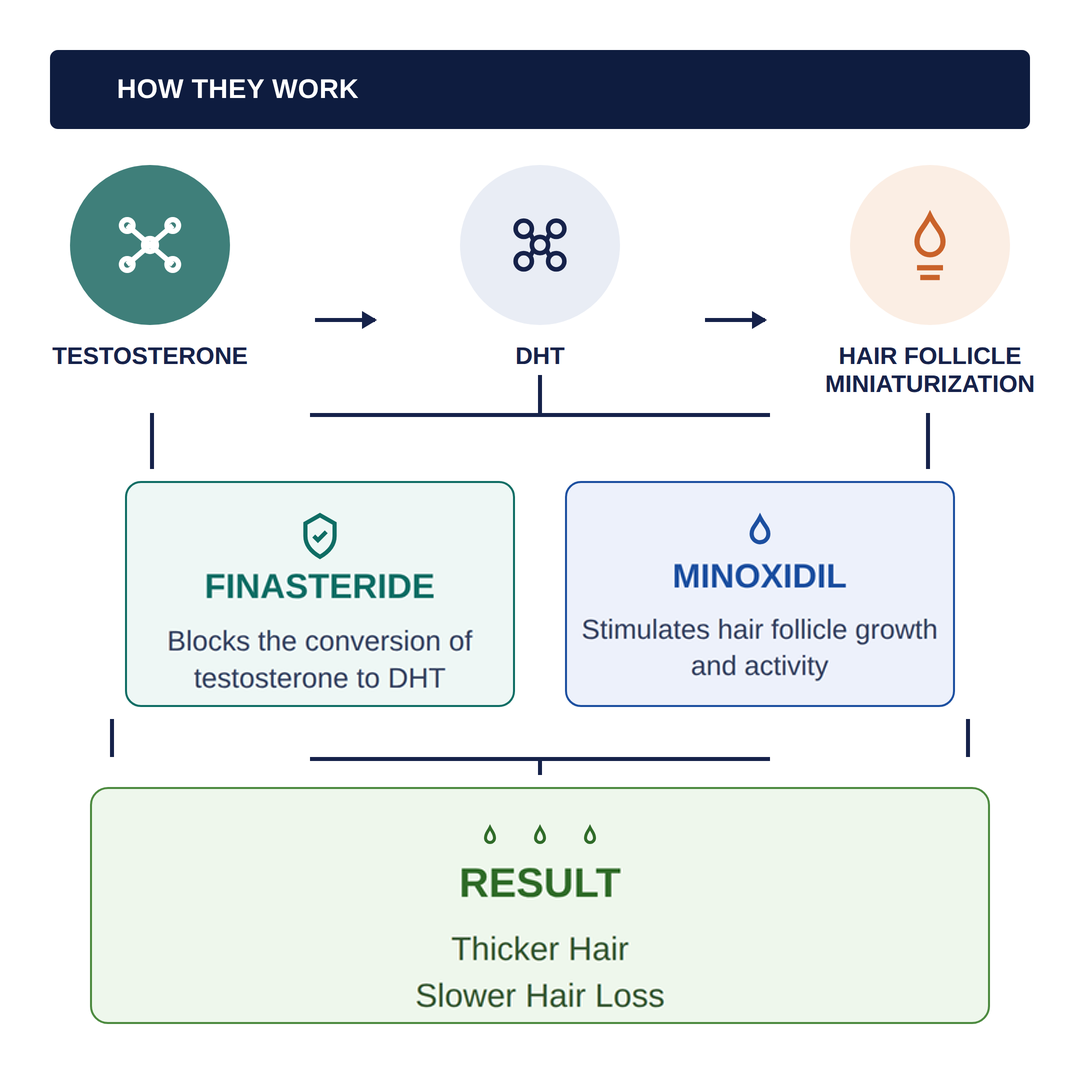
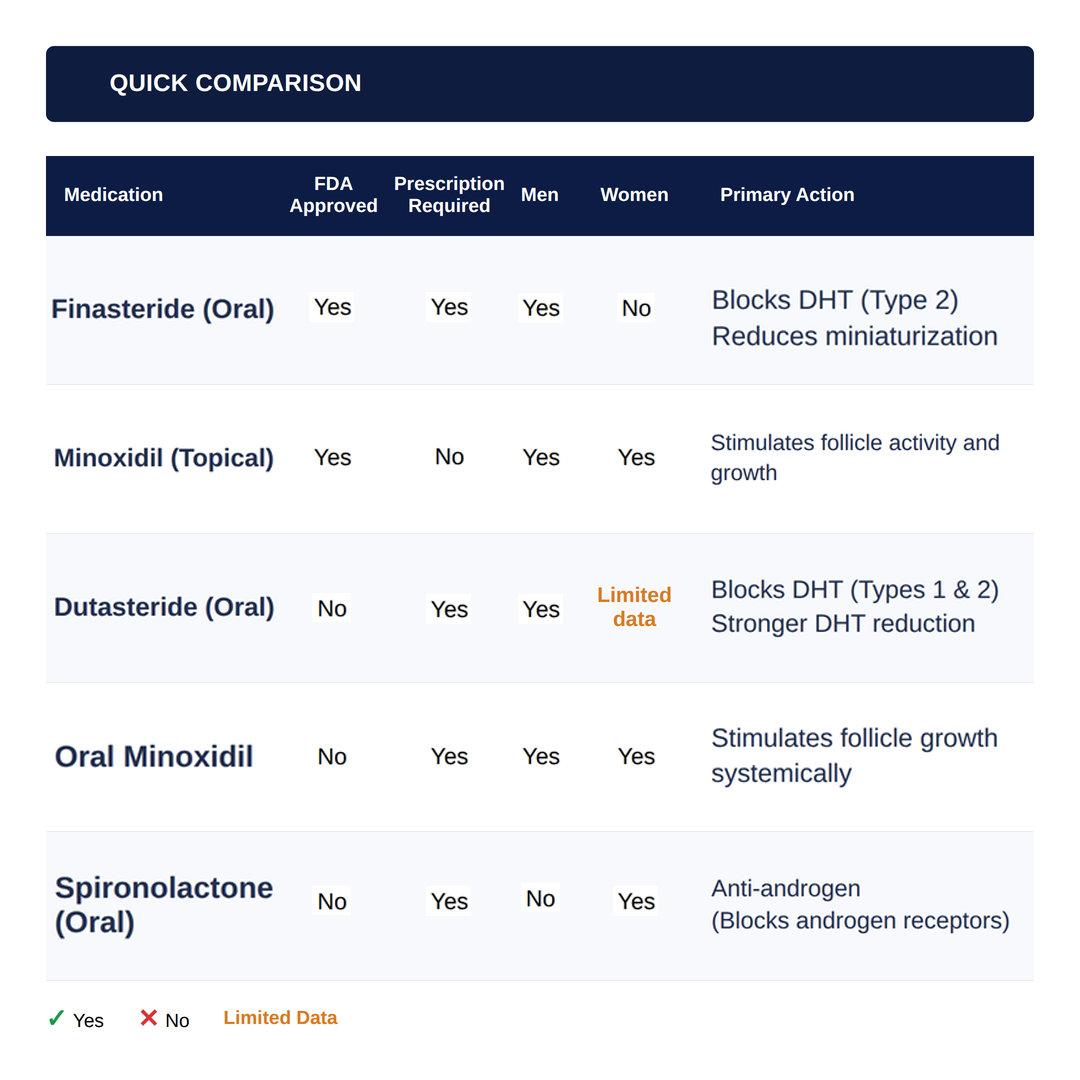
There are presently only 2 FDA-approved (for efficacy) medications for men (oral finasteride and topical minoxidil) and only 1 FDA-approved (for efficacy) medication for women (topical minoxidil). These medications are effective at slowing the miniaturization process and somewhat thickening the hair shaft to give a fuller look in the first few years of use. Eventually, all patients will resume thinning, but at a much slower rate than if they were not on the medication. Patients will lose the benefits & results if they stop the medications. Think of these medications like toothpaste: toothpaste slows tooth decay, while these medications slow Androgenetic Alopecia. There are no other medications on the market that can medically claim their product causes significant hair growth.
Finasteride (aka Propecia)
Finasteride is one of the most effective medications for treating male pattern baldness. It works by inhibiting 5-alpha reductase, an enzyme that converts testosterone into dihydrotestosterone (DHT), the primary hormone responsible for hair follicle miniaturization and hair loss in men.
By reducing DHT levels in the scalp by up to 60-70%, finasteride helps slow down hair loss, prevents further thinning, and in some cases, stimulates regrowth in areas (especially the vertex). In the five-year hair count studies in the vertex, 90% of men were doing as good if not better than, they were before starting finasteride. 64% of patients were still doing better than they were before starting treatment. This drug is most effective for hair loss at the vertex, but is still pretty good at maintaining the hair in the frontal and mid scalp.
Finasteride was only studied in postmenopausal women who showed a lack of efficacy. Dr. McAndrews does feel it’s effective in premenopausal women (if not planning to get pregnant), but there are risks if a woman were to get pregnant.
Finasteride needs to be prescribed by a physician.
Note: I have been on finasteride for the past 29 years (and plan to be on it my entire life), in addition to prescribing it for my son & relatives. I do not believe any of the internet forums that sensationalize side effects, for I rarely see side effects which are reversible with discontinuation of finasteride.
Also Read: Finasteride for Hair Loss: A Guide by Dr. Paul J. McAndrews
Topical Minoxidil (aka Rogaine)
Minoxidil is a topical treatment that may thicken and/or slow the miniaturization of the hair follicles. Its mechanism of action is still unknown. Unlike finasteride, which blocks the formation of DHT to prevent/slow hair loss, Minoxidil works on a different, unknown mechanism of action.
Minoxidil is available in 2% and 5% strengths, with the 5% version being more effective. It comes in a foam or liquid solution that’s applied directly to the scalp once or twice daily. It works best for thinning hair at the crown and vertex (top of the scalp). Studies show that 40-60% of users experience noticeable hair regrowth within 6 months.
It’s also common practice to combine the use of topical minoxidil with oral finasteride since they have different mechanisms of action. They work synergistically together with better results than either one alone in slowing androgenetic alopecia.
Topical minoxidil is over the counter (OTC); therefore, you can pick it up at any pharmacy without a prescription.
Also Read: Minoxidil for Hair Loss: A Guide by Dr. Paul J. McAndrews
“Off-label Use” Medications for Androgenetic Alopecia
There are 4 FDA-approved medications Dermatologists use to treat Androgenic Alopecia. The use of these medications for treating hair loss is called “Off-label Use”. Off-label Use means that the medication has been FDA-approved for a different symptom (i.e, hypertension); however, we are using it for a different diagnosis (i.e, Androgenetic Alopecia).
Dutasteride
Dutasteride works on similar mechanisms of action as finasteride and is potentially the most effective treatment for androgenetic alopecia. Dutasteride acts as a type 1 and 2 alpha-reductase inhibitor (dual inhibitor) and decreases serum DHT by about 90%, while finasteride reduces serum DHT by 70% by the inhibition of only type 2 5-alpha-reductase.
Dutasteride, although not FDA-approved for the treatment of AGA, is becoming increasingly used in clinics and has been shown to have better efficacy than finasteride and placebo in several studies[1]. The side effect profile for dutasteride is similar to that of finasteride. More studies need to be done to determine the efficacy in women.
A prescription is necessary to obtain this medication.
Also Read: Dutasteride for Hair Loss: A Guide by Dr. Paul J McAndrews
Oral Minoxidil
Oral minoxidil was FDA-approved in the 1960s as a treatment for hypertension. Dermatologists noticed in the early 1970s that patients taking it for their blood pressure were growing thicker and longer hair on the top of their heads, in the beard region, and on other parts of their bodies. Dermatologists then started using the blood pressure pills off-label by dissolving them and rubbing them on the heads of men with androgenic alopecia. Topical minoxidil eventually got FDA-approved for androgenic alopecia.
Many patients come in asking if they can take subtherapeutic small doses of oral minoxidil for their androgenic alopecia. The answer is “yes” since we know it is effective at reversing the miniaturization process, and it can be prescribed off-label in both men and women experiencing androgenetic alopecia. Many of these same patients also add Ketoconazole shampoo to their regimen, since it works through a completely different mechanism to support overall scalp health alongside oral minoxidil.
A prescription is necessary to obtain this medication.
Oral Spironolactone
Oral spironolactone is FDA-approved for blood pressure. One of its side effects is that it’s an antiandrogen, so we do not use it in men because it can feminize them. But Dermatologists have been using it off-label for its side effects for decades to treat two disease processes that are androgen-related: acne in women and female pattern hair loss.
A prescription is necessary to obtain this medication.
Topical Finasteride
There are some men who are resistant to taking oral finasteride who would rather use it off-label in a topical formulation. This can be done the same way topical minoxidil was prescribed off-label in the 1970s until it got FDA-approved.
Topical finasteride is nowhere close to being as effective as the oral dose since 80% of serum DHT levels are formed in the liver, which the topical formulation cannot prevent.
There is an added risk of using topical finasteride as it may inadvertently get on a pregnant partner’s skin. This risk needs to be discussed with the patient.
A prescription is necessary to obtain this medication.
Adjunct & Emerging Therapies
Ketoconazole (Nizoral)
Ketoconazole is an antifungal medication that also shows mild anti-androgenic and anti-inflammatory properties, making it a useful adjunct in treating androgenetic alopecia. It is most commonly prescribed as a 1% or 2% medicated shampoo.
What makes ketoconazole helpful for hair loss is not its antifungal action alone, but its ability to reduce scalp inflammation and create a healthier environment for hair follicles. Chronic microinflammation around follicles is believed to contribute to miniaturization in androgenetic alopecia. By reducing this inflammation and possibly lowering local DHT activity, ketoconazole may enhance the effects of other medications such as minoxidil and finasteride.
Patients typically use ketoconazole shampoo two to three times a week, alternating it with a gentle daily shampoo. While it does not cause hair regrowth on its own, it plays a supportive role in maintaining scalp health and improving the efficacy of other hair loss treatments.
Topical Dutasteride
This formulation aims to deliver the benefits of oral 5-alpha reductase inhibitors directly to the scalp while minimizing systemic exposure(like topical finasteride). Early studies suggest that topical dutasteride may effectively lower scalp DHT levels and slow miniaturization, though more long-term data are needed. For patients concerned about systemic side effects from oral versions, these topical options can sometimes offer a safer alternative when prescribed and monitored by a physician.
Prostaglandin Analogs (Latanoprost, Bimatoprost)
Originally developed to treat glaucoma, these medications were found to stimulate hair growth as a side effect. Research suggests that prostaglandin analogs can prolong the anagen (growth) phase of hair follicles. While currently more common in eyelash and eyebrow growth serums, ongoing studies are exploring their potential for scalp use in androgenetic alopecia.
Although emerging therapies are exciting, it’s important to remember that many remain in experimental phases. Always consult with a board-certified dermatologist or hair restoration physician before considering these options, as safety and long-term efficacy are still being evaluated.
Also Read: Guide to Best Vitamins and Minerals for Hair Loss
Combination Therapy and Medical Supervision
The most successful approach to managing androgenetic alopecia often involves combining treatments that target different pathways of the disease. For example, finasteride reduces DHT formation, while minoxidil stimulates follicular growth. Used together, they work synergistically to slow miniaturization and enhance visible density.
It’s important to understand that hair loss is a chronic condition. Regular follow-ups, photographic monitoring, and medication adjustments are essential to maintain results over time. Stopping treatment will cause the miniaturization process to resume, leading to renewed shedding and thinning.
Patients should never attempt self-medication or purchase products from unverified online sources. These treatments require careful medical supervision to ensure correct dosing, minimize side effects, and track effectiveness.
With consistent use, realistic expectations, and professional guidance, patients can achieve significant improvement in the density and stability of their hair, often maintaining results for many years.
Beware of the Scam Products
There are many companies and doctors who play on the vulnerability of people with hair loss. It makes the environment rich with scam products that absolutely do not slow or stop hair loss.
There are numerous unethical companies that make claims that their products “may cause fuller & thicker looking hair” and hope that you interpret that as “causing clinically significant hair growth”. If a company marketing a hair loss product does not put in writing that their product “slows and reverses the miniaturization process of Androgenic Alopecia”, there’s a reason why their attorneys won’t let them put that in writing (they don’t want to be sued). They instead use deceptive buzzwords like “may appear thicker & fuller”, “new hair growth,” “regrowth”, or “FDA-approved” (but doesn’t state “approved for efficacy”) – which is creative marketing, but not medical treatments.
Also Read: Taiwan’s New Hair Regrowth Serum: Fact or Fiction
New scam products for the treatment of hair loss are popping up every day with unbelievable claims. If a product sounds too good to be true, it is too good to be true.
Remember: FDA-approved for Safety is NOT the same as FDA-approved for Efficacy.
Worried About Hair Loss? Let’s Talk.
Get trusted answers from Dr. McAndrews, a board-certified hair restoration physician with over 29 years of experience. We offer both FUE and FUT hair transplants in Los Angeles at our Pasadena office and offer convenient online consultations that you can reserve from anywhere.
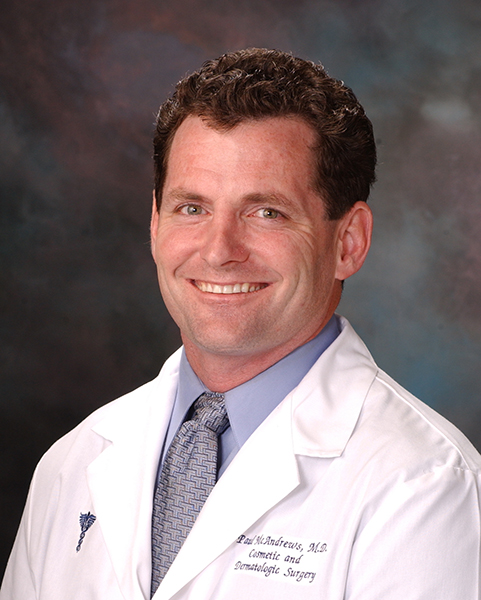
Dr. Paul J. McAndrews is a world-renowned expert in hair loss and hair restoration, and one of only two physicians to have served as President of both the ISHRS and the ABHRS. He is a Clinical Professor at USC/LAC Medical Center and an Expert Medical Reviewer for the California Medical Board, with more than 29 years of experience performing hair transplant procedures, including both FUE and FUT. Serving patients throughout Los Angeles and Southern California, he is regarded as one of the best hair transplant specialists in Los Angeles.