
Topical Pyrilutamide (KX-826) has been making the news lately as potentially being a first-in-class medication for the treatment of androgenetic alopecia. “First-in-class” means it uses a different mechanism of action than the other FDA-approved treatment options. If approved, it will be the first new therapeutic mechanism for androgenetic alopecia, the most common form of hair loss, in almost 30 years. The only FDA-approved treatments for androgenetic alopecia are: oral finasteride (approved in 1997) and topical minoxidil (approved in 1988).
What is Pyrilutamide?
Pyrilutamide (KX-826) is an experimental topical anti-androgen developed by Kintor Pharmaceuticals. It is in clinical trials in both China and the United States for the treatment of androgenetic alopecia, the most common form of hair loss.
Also Read: Taiwan’s New Hair Regrowth Serum: Fact or Fiction
How does Pyrilutamide work?
Pyrilutamide solution is an antiandrogen medication that targets testosterone and dihydrotestosterone (DHT) receptors in the skin and hair follicles. It is well known that DHT is the causative hormone involved in the miniaturization process of the hair shaft seen in the susceptible hair follicles of androgenetic alopecia. Therefore, it makes logical sense that by blocking the DHT receptors, there would be a slowing of the progressive miniaturization seen as a patient ages. The topical application aims to minimize the systemic side effects associated with oral anti-androgens.
Also Read: Hair Growth Cycle: All You Need to Know
Pyrilutamide Solution Study Results
Phase III Trial Findings
- Early trials dosing was 0.5% twice a day. The newer trials in the United States are at a 1% concentration twice a day.
- The phase II FDA trials were a randomized, double-blind, vehicle-controlled, parallel group study to scientifically evaluate the efficacy and safety of pyrilutamide in male subjects, aged 18-70 years old, with androgenetic alopecia.
- The primary endpoint for the trial is to change from baseline in TAHC (Target Area Hair Counts) at 24 weeks in comparison to the placebo group.
- The Phase II trials showed significant improvements in hair growth.
- Kintor Pharma stated they have completed enrollment of 740 men for the Phase III FDA trials.
Side Effects of Pyrilutamide
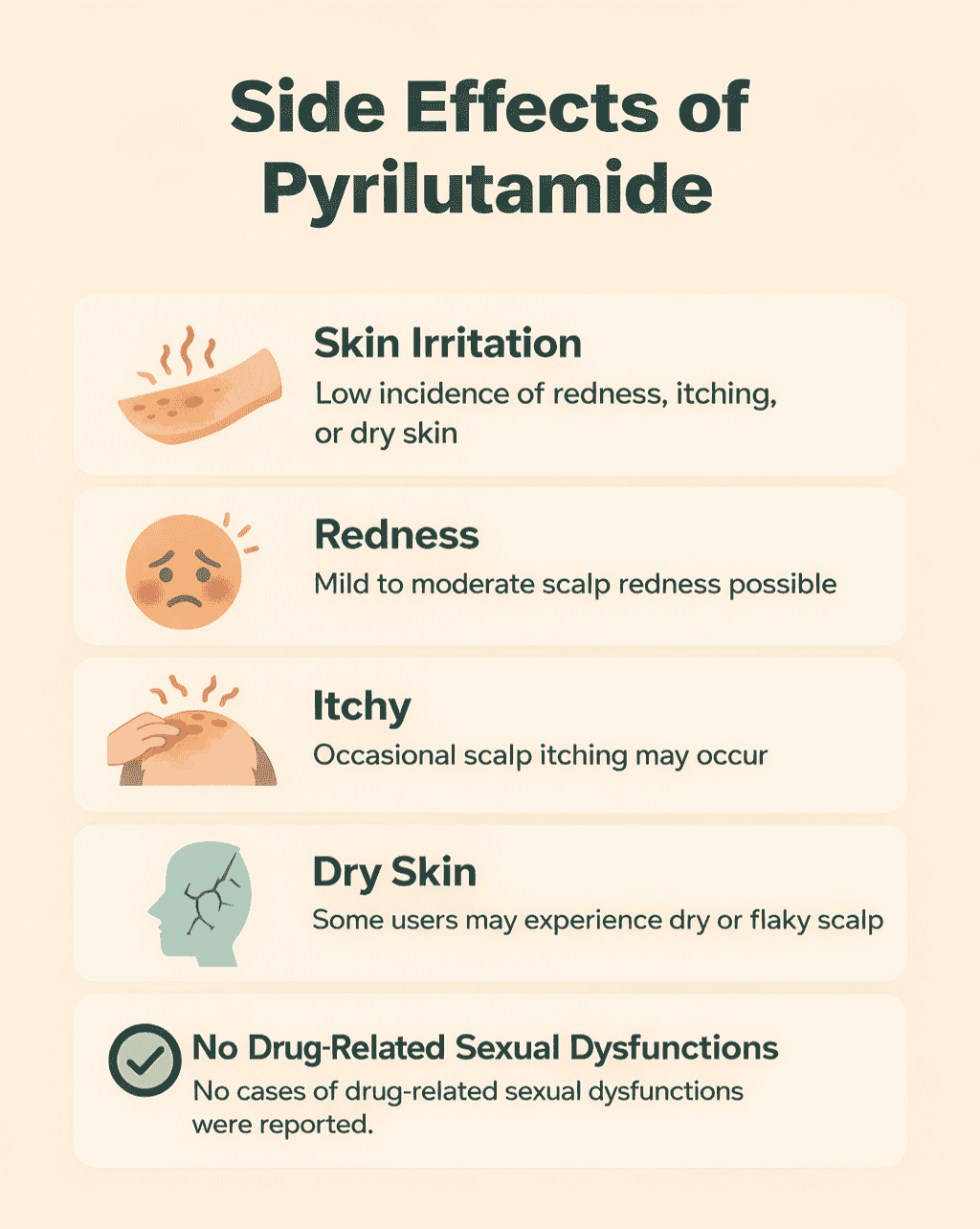
- In 2025, Kintor Pharma stated that the long-term safety Phase III clinical trials are complete, and Pyrilutamide showed excellent safety and efficacy for the treatment of androgenetic alopecia. There was a low incidence of overall adverse effects (skin irritation, redness, itchy, dry skin) and no drug-related sexual dysfunctions.
When will Pyrilutamide be Available for Hair Loss Treatment?
Kintor Pharma is still in the Phase III FDA clinical trials, which show promise, but still it isn’t FDA-approved and still requires further research. Only time will tell.
Will Topical 1% Pyrilutamide solution be approved for use in women with androgenetic alopecia?
- Clinical Trials are presently ongoing in women in China
- The present studies in the United States were only performed on men.
Also Read: Is Clascoterone the Miracle Cure for Hair Loss?
My Opinion
We currently do not have a silver bullet to treat androgenetic alopecia.
Presently, there are two FDA-approved medications in the treatment of androgenetic alopecia (the most common form of hair loss), oral Propecia (finasteride) and Rogaine (topical minoxidil). These two medications are presently the best options for managing androgenetic alopecia.
As Dermatologists (the medical experts for treating hair loss) we’re always looking for better treatments for androgenetic alopecia since we currently have no perfect treatment for this aging process. Unfortunately, since there is no perfect treatment now, it creates the perfect environment for “snake oil” products, which have been abundant over the last several decades. I believe it is imperative to keep an open, but skeptical, mind to new treatments for hair loss.
I believe topical anti-androgens like pyrilutamide hold significant promise in the treatment of androgenetic alopecia in both men and women. I am eagerly awaiting the completion of the studies. There is presently another topical anti-androgen in FDA clinical trials called 5% Clascoterone that is a little farther along than Pyrilutamide in the FDA clinical trials. I do not believe topical anti-androgens will be a silver bullet in the treatment of androgenetic alopecia, but I do believe they will become a valuable and significant tool in my tool chest in treating androgenetic alopecia in men (and hopefully eventually women).
Worried About Hair Loss? Let’s Talk.
Get trusted answers from Dr. McAndrews, a board-certified hair restoration physician with over 20 years of experience. We offer both FUE and FUT hair transplants in Los Angeles at our Pasadena office and offer convenient online consultations that you can reserve from anywhere.

Dr. Paul J. McAndrews is a world-renowned expert in hair loss and hair restoration, and one of only two physicians to have served as President of both the ISHRS and the ABHRS. He is a Clinical Professor at USC/LAC Medical Center and an Expert Medical Reviewer for the California Medical Board, with more than 20 years of experience performing hair transplant procedures, including both FUE and FUT. Serving patients throughout Los Angeles and Southern California, he is regarded as one of the best hair transplant specialists in Los Angeles.