
Four Main Steps in Both FUE & FUT
There are 4 main steps to both the FUE & FUT hair transplant process:
1. Excision of the Donor Tissue
The excision of the donor tissue from the hair bank, where the good genetic hair around the sides and back of the scalp is removed with a sharp punch excision tool, or removed as a strip excision.
2. Dissection of Donor Grafts
3. Making Recipient Incisions
4. Planting Grafts into Incisions
The only difference between FUE & FUT hair transplants is in the first step of the hair transplant process, which is removing the tissue with good genetic hair from around the sides and the back of the scalp. We’ll explain this in more detail in the next sections.
The next three steps of the hair transplant process should be the same; unfortunately, the vast majority of doctors performing FUE hair transplants do not dissect the hair under the microscope, which is vitally important.
BEWARE: if you’re having an FUE hair transplant, ask your doctor if they use the stereoscopic microscope to dissect the grafts, and if they don’t, reschedule your surgery with a different doctor.
What Is FUE & FUT?
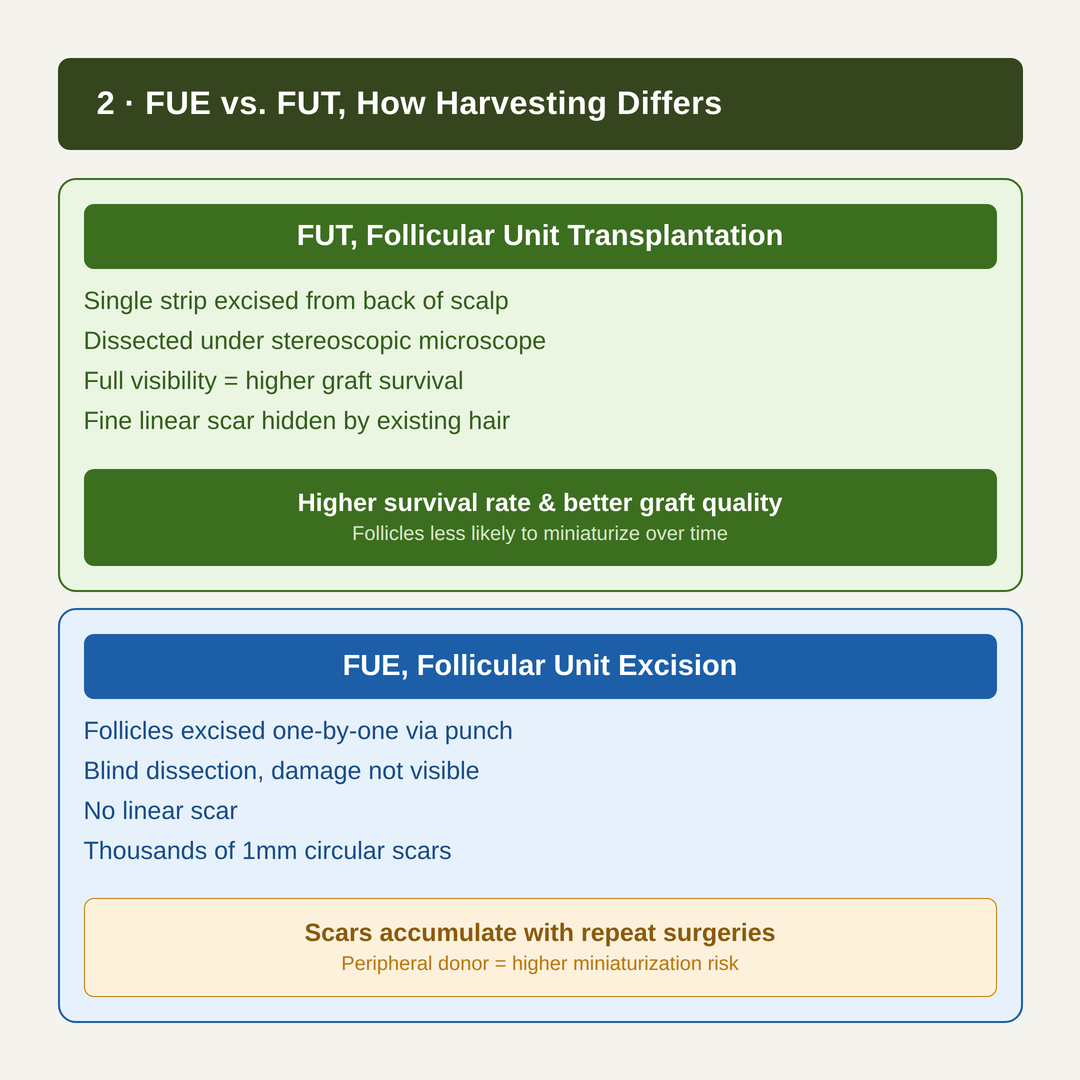
Follicular Unit Excision (FUE), a form of punch excision, involves using a sharp punch excision tool or motorized drill to surgically excise hundreds to thousands of pieces of hair-bearing tissue from the donor area in the sides and back of the scalp.
This method leaves hundreds to thousands of small circular scars that are barely visible, even with short hair.
Follicular Unit Transplantation (FUT), a form of strip excision, involves removing a thin strip of scalp from the back of the head.
The donor tissue is dissected under a stereoscopic microscope in order to maximize survival of the isolated follicular unit grafts.
This method leaves a linear scar in the donor site hidden by the surrounding hair.
Detailed Differences Between FUE & FUT Hair Transplants
Graft Excision
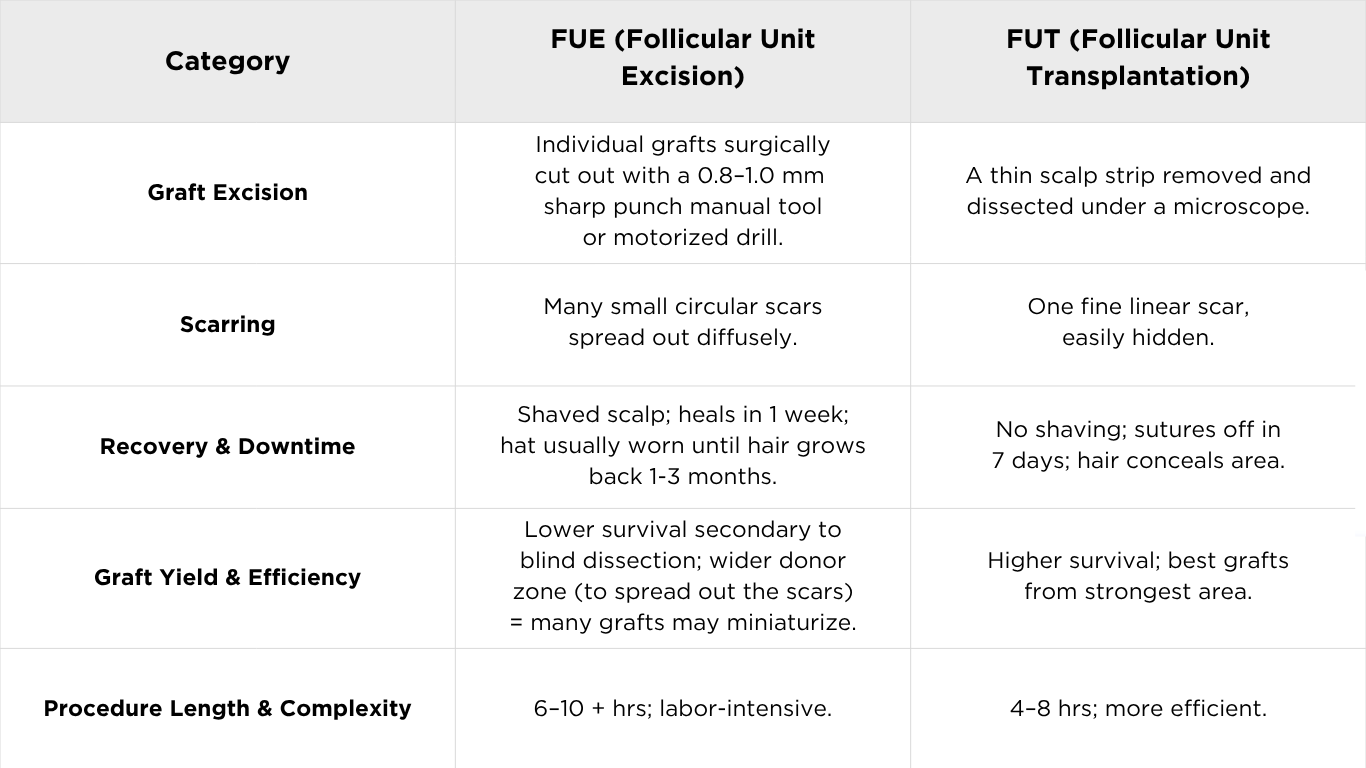
FUE – surgically cuts tissue from the scalp using a sharp circular punch excision tool (usually 0.8–1.0 mm). The surgeon surgically excises thousands of grafts one at a time, working across a broad donor area to avoid overharvesting in any one spot.
FUT – involves removing a thin strip of scalp from the back or sides of the head. This strip is precisely removed from the area of the best genetic quality hair. The tissue is then dissected under a stereoscopic microscope to carefully isolate intact follicular unit grafts. It preserves more of the surrounding donor zone for future procedures.
Scarring
FUE – leaves thousands of small circular scars across the donor area. These are minimally visible and generally heal well, even if you wear your hair short. FUE creates approximately 12 times as much surface area of scar compared to FUT, but it’s diffuse. The advantage of FUE is that it doesn’t create a linear scar. Overharvesting or poor technique can create patchiness and a moth-eaten look in the donor region. With subsequent surgeries, the prior scar tissue is not removed, so more and more scar tissue accumulates with each subsequent procedure.
FUT – leaves a linear scar where the strip was taken. If performed by an experienced surgeon using a trichophytic closure, the scar can be very thin and easy to conceal with very short haircuts. FUT is often preferred by patients who want the best quality and survival of the grafts, do not plan to shave their head, and/or want to preserve donor density. With subsequent surgeries, the prior scar is removed and replaced by a new scar.
Recovery & Downtime
FUE – The scalp is typically shaved in order to get the circular punch over the desired hair follicle graft. The hundreds to thousands of small circular excision holes typically heal up over the week, as does the recipient site if it’s covered with a gel layer. The thousands of small circular scars are red and noticeable until your hair grows long enough to cover them. Most patients return to normal routines within 7 days with a hat on.
FUT – The scalp is not shaved and left as the patient normally wears his/her hairstyle. FUT requires sutures at the donor site, which is covered by the existing hairs, so on surgery day, no one can tell where the tissue was removed. The sutures are removed in 7 days. There may be a little discomfort in the donor area during the first few days of recovery. Most patients feel comfortable going outside without a hat one week after the surgery since they have plenty of hair to hide the healing process.
Related Articles to Recovery
Should You Avoid Coffee After a Hair Transplant?
Can I Drink Alcohol After a Hair Transplant?
Can I Smoke Before and After a Hair Transplant?
Graft Yield & Efficiency
FUE – yields decreased graft survival since FUE punch excisions are a blind dissection. Blind dissection means you don’t see if you transected the follicle until it’s already happened. FUE yields fewer quality grafts since grafts are removed from a broader area to spread out the thousands of small circular scars. The grafts removed from the periphery are more likely to miniaturize as the patient gets older.
FUT – allows the surgeon to dissect the tissue under the stereoscopic microscope, which enables him to have full visualization while separating the follicular unit grafts. This full visualization increases the survival of the grafts. FUT also allows the surgeon to pinpoint tissue removal from the area of best genetic hair; therefore, it leads to better quality grafts over the long run. It also preserves donor availability for future transplants.
Procedure Length & Complexity
FUE – takes longer due to the labor-intensive nature of punch excising each graft individually. A session can take 6–10 hours or more, depending on graft count.
BEWARE: the surgical punch excisions of these grafts should only be performed by a medical doctor. Unfortunately, in order to automate this process, many unscrupulous doctors have technicians (with no medical license) surgically cut out patients’ tissue with the punch excision tool/drill. This is criminal since it’s practicing medicine without a license.
FUT – takes 4 to 8 hours to complete. It is still time-consuming since every graft must be meticulously dissected under the microscope into follicular unit grafts.
Good Candidates
FUE – over the age of 50+, prefers short hair styles, does not want stitches or a linear scar, plans on only having 1-2 surgeries in their lifetime (since the punch excision scars accumulate with each successive surgery). In the short term, they don’t mind shaving their head before the surgery.
FUT – prefers longer hair styles, wants the maximal survival of their good genetic hair, wants the best quality of transplanted grafts, wants to preserve donor hair for potential future surgeries (less overall scar tissue in the donor area). In the short term, he does not want to shave his head around the surgery since he wants no one to know he’s having a hair transplant.
Combining FUE and FUT
When planning hair restoration, it is important to think beyond a single procedure. Many patients will need more than one hair transplant in their lifetime, and the way the first surgery is done can affect what is possible later.
Also Read: How Long Do Hair Transplants Really Last?
In some cases, a combination of FUT and FUE can provide the best long-term results. For example, I often recommend starting with FUT (strip surgery) because it allows us to remove a high number of quality grafts from the strongest donor zone while preserving the surrounding areas.
This helps maintain the overall health of the donor region for future use. If additional coverage or refinement is needed in the future, FUE can then be performed to selectively remove grafts from other areas of the scalp. This sequence, starting with FUT and later using FUE, gives patients the most flexibility and the highest lifetime graft yield. This combined approach works because each method complements the other.
FUT preserves donor density by keeping the excision area limited, while FUE provides the ability to fine-tune results. By planning the sequence carefully, a patient can achieve natural coverage today and still have enough donor hair available for potential procedures later in life. Maintaining scalp health with supportive treatments like Ketoconazole throughout this multi-year process can also help protect existing, non-transplanted hair along the way.
So, FUE or FUT Hair Transplants?
It is for you to decide. Each individual patient is unique, and each hair transplant procedure is highly case-specific. The best hair transplant method depends on the patients’ goals, hair loss pattern, and donor area. Both techniques are permanent and produce natural-looking results when performed by an experienced and formally trained hair restoration surgeon.
The best way to know which option (FUE versus FUT) is best for you is to schedule a consultation with a board-certified dermatologist and hair-restoration surgeon to diagnose and evaluate your particular hair loss & hair restoration goals.
Worried About Hair Loss? Let’s Talk.
Get trusted answers from Dr. McAndrews, a board-certified hair restoration physician with over 29 years of experience. We offer both FUE and FUT hair transplants in Los Angeles at our Pasadena office and offer convenient online consultations that you can reserve from anywhere.
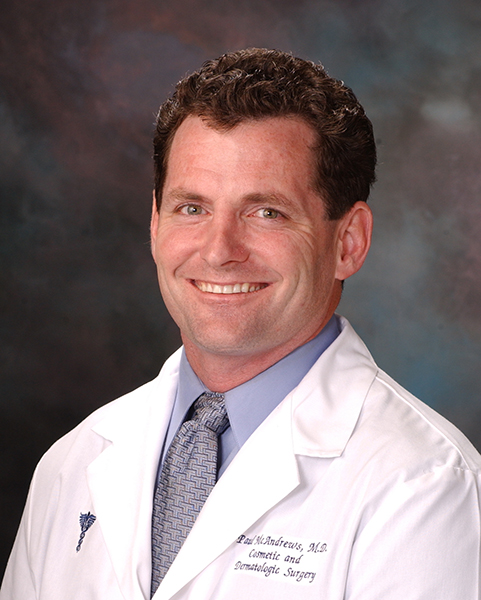
Dr. Paul J. McAndrews is a world-renowned expert in hair loss and hair restoration, and one of only two physicians to have served as President of both the ISHRS and the ABHRS. He is a Clinical Professor at USC/LAC Medical Center and an Expert Medical Reviewer for the California Medical Board, with more than 29 years of experience performing hair transplant procedures, including both FUE and FUT. Serving patients throughout Los Angeles and Southern California, he is regarded as one of the best hair transplant specialists in Los Angeles.